By Lodwin Gatsi
Introduction
This article is a testimony of how “China First” means the “World first” as intimated in the thought of Community of Shared Future for Mankind driven by successful Socialism with Chinese characteristics by his excellency Xi Jinping in his series of Governance of China, books. Following forty-five years of cooperation between Zimbabwe and China the article reflects on how the Zimbabwean tobacco industry has transformed to the benefit of not just the two countries but the region as well. The success of the cooperation is driven by harmony between the African Ubuntu and Chinese traditional philosophies underpinned by humanness.
45 Years of growth
My first encounter with Chinese ideology is exactly 45 years ago just before starting primary school. It was in a popular liberation war song sung by local soldiers called “Nzira dzemasoja, a song about relations between the army and the people where Chairman Mao was emphasizing that the army should rely on the people and believe firmly in the inexhaustible creative power of the masses. Second time was still a literary encounter in first years of high school where part of our history curricula included Marxism as taught by Chairman Mao.
The third encounter and most profound with life changing effect far beyond myself and our country was an intellectual engagement when I visited Beijing in 2004 on behalf of the government of Zimbabwe to defend and support a position for China Tobacco to participate directly in the Zimbabwean Tobacco industry. In the aftermath a government- to-government agreement was signed in 2005 initiating the direct participation of China Tobacco in Zimbabwe.
This has not only benefited local farmers but a greater part of the population, local industries as well as other regional countries with market access and concessionary funding for growers.
Personally, I have benefited from exposure to the rich and holistic philosophy of life expounded in the traditional Chinese philosophy of Changes, the Yi Jing. As an independent researcher I have been inspired by Chinese Philosophy to come up with a new practical, transformative and holistic framework for Sustainability as well as a book with the same title as this article “China First” the “World First”. This article is therefore just a precis of the book highlighting how a “China First” that means “World First”.
Classic philosophical relationship
China tobacco in Zimbabwe is one classic case that qualifies for the most profound social-economic relationship the world over. While on the surface it could be read as an ordinary government to government economic tie, a deeper analysis reveals an intriguing cultural and philosophical foundation rooted in the African ubuntu and Chinese traditional cultures.
At the centre of the tobacco relationship connecting the two countries is Tian Ze Tobacco Company. Several years after joining this company, I visited my grandmother and on telling her about the new company she confused it with a local Shona language name “Tenzi which can be translated to mean Lord. This made me curious to find out the Chinese meaning of Tian Ze. I ended looking up the two terms including Tian Zi which came up in the searches. What I found out and how Tian Ze has shaped the industry is beyond just names and symbolic.
Beyond just a name
The term Tian Ze in Chinese combines two characters with rich symbolic meanings. Tian translates to heaven or sky, representing the cosmic order, divine authority, or the natural universe in Chinese philosophy. Ze means beneficence metaphorically, connotating grace, favour, or kindness or blessings that nourish like water. Together, Tian Ze can be interpreted as heaven’s grace or celestial beneficence, suggesting blessings, favour, or nurturing influence from Heaven or a higher power.
Tian Zi turned out to mean the same as Tenzi in Shona. It is a classical Chinese title meaning Son of Heaven as is Tenzi to Lord in Shona and holds profound historical, political, and philosophical significance in Chinese culture. The title Son of Heaven signified that the emperor or king derived his authority directly from Heaven. He acted as an intermediary between Heaven and Earth, responsible for maintaining cosmic and social harmony. The emperor was expected to rule with virtue , justice, and benevolence. The emperor performed rituals at the Temple of Heaven in Beijing to ensure agricultural prosperity, seasonal cycles, and alignment with the natural order.
Whichever symbolic meaning one wants to take Tian Ze, Tian Zi or Tenzi the coming of Tian Ze has been indeed a heavenly blessing which has not only nourished the tobacco industry in Zimbabwe from the brink of collapse but the agricultural sector in Zimbabwe at large fulfilling the economic dreams of the economic liberation struggle against colonial rule.
Following the agrarian land reform in 2000, by 2008 the Zimbabwean tobacco annual crop production had declined from an average of 200 000 tons to just about 45 000 tons. The major reason was that the financial system in place then, was not prepared to finance the new indigenous farmers who had no collateral and no experience. Tian Ze did not only come with concessionary loans at no interest but had the kindness and benevolence to trust these new farmers with financial support and a virtue to give higher prices beyond the traditional price ceilings - all justifying the symbolic meaning of its name by practice!
From the surface some might fail to appreciate the significance of this relationship. China assisted Zimbabwe in the war of liberation against colonial rule and the Land and agrarian reform, 20 years down the line the land reform in 2000 was a continuation of this struggle, to economically impower local people. The presence and operations of Tian Ze helped resuscitate the soul of the nation in agriculture by injecting life in the tobacco industry, a cornerstone of agriculture in Zimbabwe. Tian Ze has so far injected US$1.3 billion in funding and the tobacco crop reached 296 million in 2003 and now 1.5 million livelihoods now depend on this sector.
Socio-Economic impact
The statistics below show the impact of Tian Ze in Zimbabwe tobacco comparing the period just before the entry of Tian Ze and current status.
Table
Prior (2008) | Current (2025) | |
Number of growers | 35,000 | 125,000 |
Crop size | 45, 000 tons | 320,000 tons (estimate) |
Top price | US2.99/kg | US5.80/kg |
Area planted | 60,000 hectares | 120,000 hectares |
Exports to China | 18,000 tons | 80, 000 tons |
Prior to land reform one such farmer a Mr. Sam Ruzawi was growing 2 hectares of tobacco and is now growing 400 hectares of tobacco under the Tian Ze tobacco contract farming scheme and 200 hectares of wheat, utilising irrigation systems acquired under contract tobacco farming scheme. The agricultural sector is therefore pivoting on the capitalisation and the growing stability of the tobacco industry with Tian Ze amongst other contractors providing local support and a solid global market for tobacco.
All this has been made possible by a background of convergent worldviews of the African ubuntu and Chinese tradition both grounded on humanness, prioritisation of ethical behaviour, interconnectedness, social harmony and compassion both advocating treating others with empathy.
Global Context
It would be amiss not to look at the relationship between Zimbabwe and China from a global context especially from the background of the recent upheaval in global trade emanating from the America First policy by the new US Administration. The crossroads of Western and Chinese cultures have become a key focal point of geopolitical and socioeconomic concern for all nations.
Before highlighting why, we should trust China to soar above this binary framework and explicate a China First that means World first, it is important to paint a worldview background of the key philosophies around the world to show how they are not competitive but complementary and all necessary parts of a whole.
The worldviews around the world are all about how different people value individuals and society in the interaction with the environment from single objects to the cosmos as artistically depicted in the diagram below into a constellation of complementary philosophies that complete a whole.
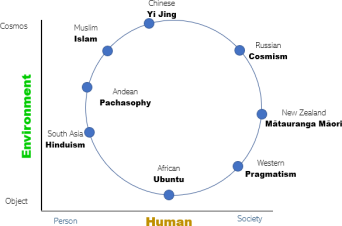
Adapted from Philosophy of Sustainability by Istag, 2025
From the diagram above. the Chinese philosophy emphasizes cosmic significance for both individual and society whereas Western philosophy is focused on objects for society to amass wealth.
From a philosophical point of view, it is fascinating how the two vast, ancient civilizations Chinese and Western, navigate values, traditions, and modernity in strikingly different yet ultimately complementary ways in the progress of the universe. By juxtaposing Western individualism, rooted in Greco-Roman and Enlightenment ideals, with Chinese collectivism, shaped by the Chinese traditional philosophy and millennia of unified history stretching and continuously flowing over the past 5000 years, one can find not only contrasts but also unexpected parallels, that merit and explicate a “China First” that speaks to the “World first”.
The Chinese philosophy of Change offers a framework that transcends binary thinking, fostering cross-cultural dialogue and adaptive solutions in an era of rapid disruptive change. The Chinese holistic approach reveals hidden connections between local values and global systems, urging us to see uncertainty and differences not as threats but as a catalyst for innovation.
In this time of fragmentation, the chinese philosophy can help leaders to ask better questions and not cling to easier answers. The Chinese philosophy offers a refreshingly holistic vision that bridges empirical rigor and cultural wisdom, challenging leaders to abandon zero- sum paradigms and politicians to craft policies rooted in fluid realities, not fossilized ideologies.
The following fundamentals of Chinese intellectual heritage are a very strong foundation for China to do more of what it has been doing for the benefit of a shared future for mankind.
China’s intellectual Heritage
Cradle of philosophy
The 3000-year-old holistic traditional chinese philosophy of Changes the Yi Jing by Master Fuxi predates the recognised onset of western philosophy by the Ionian Greek philosophers. The striking similarity between the Yi Jing and early Greek philosophy originating in Ionia therefore point to Oriental influence, given that Ionia was the meeting place of West and East. Supporting this line of thinking is the fact that the fascination on Change by the Greek Philosophers like Theogonies, was more poetic as opposed to the detailed theoretical outlay of Change in the Yi Jing. The equal treatment of opposites as expressed in the Yin Yang was fundamental to the establishment of science on formulating and solving equation problems in mathematics, physics, chemistry. The Chinese generations should remain aware and hold dear this heritage of a being the cradle of philosophy and that they are yet to fully utilise the full potential of the Yi Jing as a resource for innovation because philosophy as a thinking framework precedes science.
Heritage of practical innovation
Chinese innovations have been celebrated not merely for their ingenuity but their profound focus on resolving pressing societal challenges and were not driven by competition or pursuit of profit. China’s technological legacy exemplifies how solving societal needs can spur advancements that endure millennia. In an era where global challenges demand cooperative solutions, it is our hope that China continues to tread on its philosophy beyond and above competition lens. China's four great inventions - papermaking, the compass, gunpowder, and printing came about not for or by global competition but to solve societal problems. The world needs more of this approach than a focus on meaningless accumulation of wealth.
Beyond fixed objects
The greatest difference between Western and Chinese philosophy is the basis of reality. Many philosophers in the West, such as Heraclitus, Hegel, and Nietzsche advocated the idea that change and becoming are the nature of reality. However, when Plato one of the greatest Greek philosophers chose the side of being as the foundation of reality and knowledge, Western philosophy marginalized the other side of becoming as either subsidiary or even an illusion of being.
Contrary to the Platonic tradition, the Chinese Philosophy of Change privileges the side of becoming. Reality is a flow of becoming before anything comes into being, a flow without distinction between being and non-being, thing and nothingness, substance and emptiness. To know anything, one needs to understand the becoming of that thing, where and how it arises during the process of becoming.
In the Chinese tradition, the nature of change is becoming, the principal source from which all things come into being and cease to be. Prior to anything there is nothing but the flow of change. According to the Chinese Taijitu, change changes as an undifferentiated whole and differentiates itself into innumerable forms and movements.
Motor vehicles, fossil fuel, mobile phones, solar panels, mobile phones, tariffs and any other objects we can think of are fixed objects and are all but phases of reality that will come to pass. Therefore humanity should be inspired by the Chinese tradition of change to operate with an open mind to imagine different possibilities we are yet to enjoy.
Above competition
A focus on fixed objects is the source of competition that hinders innovation. At the heart of Chinese traditional philosophy, change is not a battle ground of opposing forces but a cyclical dance of complementary energies. Transformation arises from balance rather than conquest. This cosmology rejects zero-sum competition instead teaching that change is not driven by ambition or rivalry but attunement to the cosmos. Progress arises from collective ethics and not individual triumph.
Going forward
Financial Services
From a business perspective, one area of great potential cooperation is in financial services including loans, infrastructure investments, insurance and currency swaps to help foreign currency shortages, especially to service proven value chains like tobacco . A value chain like the tobacco industry has great potential for financial services expansion within and in support of upstream and downstream industries. The tobacco industry is a great nucleus or model to pivot expansion into other sectors of the economies.
Beyond ESG
From an intellectual perspective, it is worthwhile to create a platform for intellectual exchange with a focus on practical philosophy to drive theoretical and practical innovation. Groundbreaking innovation often comes through philosophical synthesis that thrives at the intersection of diverse intellectual traditions. Combining holistic Chinese philosophy which provides a big picture perspective and the largely critical African enquiry influenced by western analytical philosophy will likely drive theoretical and practical innovation to new heights. One such key area to focus on for interdisciplinary research project is a new holistic Sustainability framework based on theoretical research. The world is currently depending on contingent ESG matrices and surely, humanity can do better than the arbitrary ESG practice.
The world urgently needs a new transformative and inclusive Sustainability Framework to solve the climate challenges. The climate challenges are a result of centuries of humanity’s certain way of solving problems rooted in philosophy and science. Reversal of these challenges means a review of our philosophies. China has a heritage of solving big social problems and can still play that role to rethink the sustainability framework.
Conclusion
In conclusion tobacco industry cooperation between Zimbabwe and China prove that by intertwining ancient wisdom with well thought modern policy, China’s modern development is not isolationist but a pathway to global harmony where “China First” means “World First”. While every other country has the freedom to focus on “itself first” and none has so far been comparable to the harmonious approach by China. As the world grapples with inequality, climate change and instability, the perception of “China First” “World First” offers a philosophical and practical model for collective flourishing – proving that a thriving China is indeed a cornerstone of global equitable world order where nations cooperate and strive for common goals, peace, security and prosperity emphasizing mutual benefit rather than zero-sum game.
It is our hope that the next 45 years will realise exponential growth in many spheres of cooperation between Zimbabwe and China.