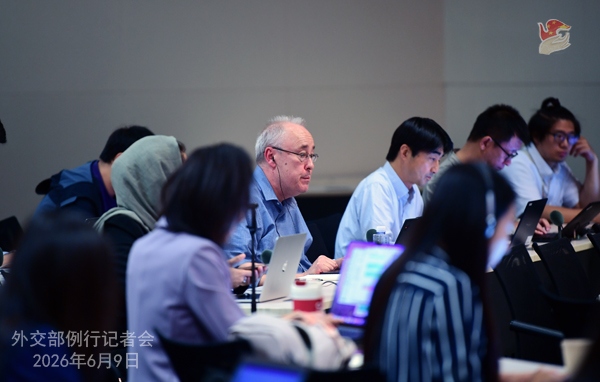
RT: Kaja Kallas, the EU High Representative for Foreign Affairs and Security Policy, recently announced that the EU will allow vessels operating under its Mediterranean naval mission to inspect and seize tankers suspected of transporting Russian oil, because they pose a danger, and the idea is to curb Russia. Earlier this month, the French Navy, joined by UK forces, seized an oil tanker sailing out of Russia. What’s China’s comment? Do you think this will affect normal international energy shipping?
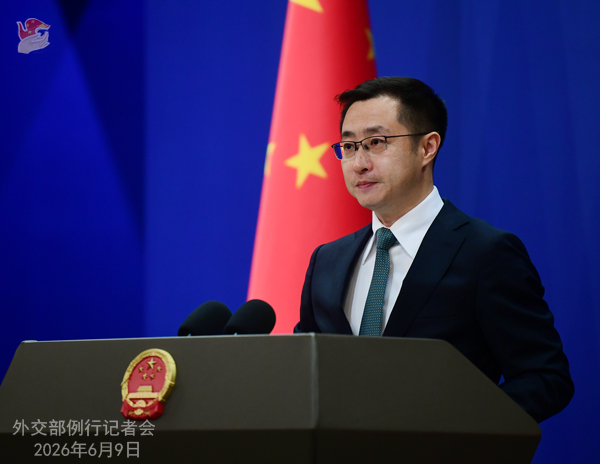
Lin Jian: We have taken note of relevant reports. China always stands firmly against illicit unilateral sanctions that have no basis in international law or the authorization of the UN Security Council. We call on the parties concerned to find solutions through dialogue and consultation.
Yonhap News Agency: Leaders of the DPRK and China had a meeting in Pyongyang on June 8, and I’d like to ask three questions. First, the Chinese readout did not include denuclearization of the Korean Peninsula. Did the two leaders discuss this issue in their meeting? Second, Chinese leader mentioned exchanges in diplomacy, law enforcement, and military in yesterday’s talks. Does that mean China and the DPRK will carry out military cooperation in the future? Third, during Chinese and Russian leaders’ meeting in May, they stated that China and Russia would continue trilateral consultations with the DPRK on the issue of access to the sea via the Tumen River. Was this issue discussed during yesterday’s meeting?
Lin Jian: China has released a readout on the China-DPRK leaders’ meeting. On your first question, China maintains continuity and consistency over its position and policy on the Korean Peninsula issue.
On your second question, I’d refer you to competent authorities for anything specific. China stands ready to enhance exchanges with the DPRK in diplomacy, law enforcement, military and other fields, pooling wisdom and strength for the growth of our bilateral relations.
On your third question, information will be released in a timely manner if there is any.
The Paper: We noted that the Chinese government released yesterday China’s National Report on the Implementation of the New Urban Agenda titled Advancing the 2030 Agenda for Sustainable Development through High-Quality Urban Development. Executive Director of the United Nations Human Settlement Program (UN-Habitat) Anaclaudia Rossbach and others from the international community have spoken highly of the report, stating that China’s experience in urban development offers valuable lessons for Global South countries. What is your comment?
Lin Jian: This year marks the fifth anniversary of the Global Development Initiative (GDI) proposed by President Xi Jinping, and the tenth anniversary of the adoption of the New Urban Agenda at the UN Conference on Housing and Sustainable Urban Development. This report summarizes China’s progress in implementing the New Urban Agenda and shares with the international community China’s experience in advancing sustainable urban development.
In recent years, adhering to President Xi’s vision of building people-centered cities, China has made remarkable progress in advancing a new type of people-centered urbanization, with urban spatial layout continuously optimized, urban amenities further improved, living environment increasingly comfortable, and urban governance more efficient. I’m sure that many of you here today can relate to that. The “China Travel” experience—safe, comfortable, and futuristic—has earned Chinese cities a reputation overseas. In the meantime, we also share our experience of urban governance and development with countries around the world particularly those from the Global South, promoting exchanges in areas such as housing development, green and low-carbon development, and smart cities. Besides, China is actively engaged in cooperation with UN-Habitat. Through events celebrating World Cities Day and the Global Award for Sustainable Development in Cities (Shanghai Award), China is supporting UN-Habitat in advancing the New Urban Agenda, winning broad recognition from the international community.
China stands ready to work with countries around the world to continue advancing the Global Development Initiative, deepen exchanges and cooperation in urban development, and inject further impetus into the advancement of the 2030 Agenda for Sustainable Development.
Bloomberg: Can you tell us more about the floating structure flagged by the Philippines in the South China Sea and any diplomatic actions that are underway?
Lin Jian: Huangyan Dao has always been China’s territory. China has indisputable sovereignty over it and its adjacent waters. It is fully within China’s sovereign rights to carry out activities including scientific research at Huangyan Dao. China urges the Philippines to stop all infringement activities, provocations and false accusations at sea.
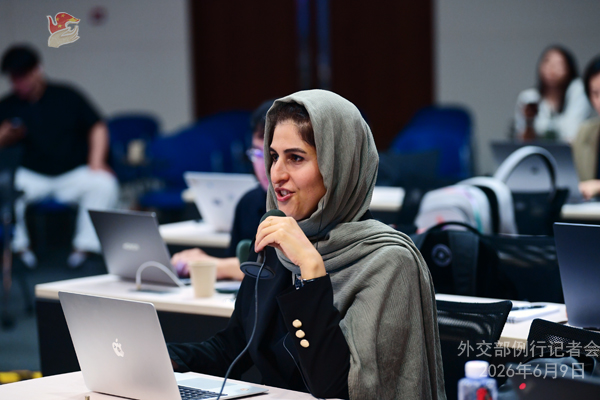
Islamic Republic of Iran Broadcasting: The United States through its sea blockade and Israel through its continued attacks on Lebanon are violating ceasefire agreements with Iran and undermining ongoing negotiations and diplomatic efforts. As we saw yesterday, such actions can force Iran to respond, and the situation can escalate very quickly. It seems Israel is trying to draw Washington into another unjust illegal war in West Asia. What is China’s position on these violations and actions that undermine diplomatic efforts as a global power and a permanent member of the UN Security Council? What can China do practically and not just verbal condemnation to help prevent another U.S.-Israeli war against Iran and promote a peaceful resolution?
Lin Jian: The three-months-long U.S.-Israel-Iran conflict has hit hard countries in the Gulf and wider Middle East region. Facts have proven that military means provide no solution, and arbitrary use of force will only complicate the issue. At this critical juncture of Iran-U.S. negotiation, no one shall reignite military conflict. Regional countries’ sovereignty, security and territorial integrity should also be respected and upheld. China calls on relevant parties to remain calm, exercise restraint, stop any confrontational action that may escalate the conflict, take concrete actions to cool down the situation, resolve disputes through political and diplomatic means, and work for an early realization of a comprehensive and lasting ceasefire. China stands ready to act on the spirit of the four propositions of President Xi Jinping, make further effort for ceasefire and peace, and continue playing a positive role for restoring peace and tranquility to the Middle East and Gulf region at an early date.
NHK: On the denuclearization of the Korean Peninsula, you just said that China’s position on the Korean Peninsula issue maintains continuity and consistency. Does “continuity and consistency” mean China will continue promoting denuclearization of the Korean Peninsula?
Lin Jian: I just answered this question.
AFP: The U.S. has put several Chinese technology companies including Alibaba, Tencent, BYD on a list of firms that it says aid China’s military. I just wondered what China’s response to this is?
Lin Jian: China firmly opposes the U.S. overstretching the concept of national security and formulating various types of discriminatory lists to go after Chinese businesses. We urge the U.S. to correct its wrongdoings, and stop the unwarranted suppression of Chinese businesses. China will do what is necessary to firmly protect their legitimate and lawful rights and interests.
TV Asahi: According to reports, China Coast Guard vessels sailed in the “exclusive economic zone” near Yonaguni Island of the Okinawa Prefecture earlier this month. In response to Japan Coast Guard’s call, the Chinese side claimed that they were conducting routine patrol in areas under China’s jurisdiction. Can you confirm this?
Lin Jian: China Coast Guard (CCG) has released information on the law enforcement patrols of the CCG vessel formation in waters east of China’s Taiwan island in accordance with the law. Let me reiterate that China has exclusive economic zone and continental shelf in this area. Japan and the Philippines bypassing China to initiate the so-called maritime delimitation talks constitutes a severe violation of UNCLOS and other international laws and basic norms governing international relations. It also seriously infringes on China’s maritime rights and interests. China will by no means accept this.
Bloomberg: The Nikkei is reporting that the U.S. has asked China to resume rare-earth exports to Japan. Can you give us any details on that?
Lin Jian: For anything specific, I’d refer you to competent authorities. Let me stress that in accordance with laws and regulations, China banned the export of all dual-use items to Japanese military users, for Japan’s military use, and for any other end-users and end-use purposes that could help enhance Japan’s military capabilities. The aim is to contain Japan’s remilitarization and its attempt to possess nuclear weapons.
Yonhap News Agency: Taiwan’s “foreign ministry” said that on June 8, three ROK lawmakers met with Taiwan’s Deputy Foreign Minister. The two sides exchanged views on addressing geopolitical challenges and the development of the semiconductor and AI industries. What is your comment?
Lin Jian: Taiwan is part of China. There is no such thing as “foreign ministry” of Taiwan. China firmly opposes official interactions of any form between China’s Taiwan region and countries having diplomatic relations with China. The 1992 joint communiqué on China-ROK diplomatic ties clearly stipulates that the ROK recognizes the People’s Republic of China as the sole legal government representing China and respects China’s position that there is but one China in the world and that Taiwan is part of China. Since early this year, the ROK has publicly reiterated on multiple occasions that its commitment to the one-China principle remains unchanged. China has lodged serious representations with the ROK over the matter you mentioned. We urge the ROK side to bear in mind the bigger picture of our bilateral relationship, honor its commitments and earnestly adhere to the one-China principle. The ROK side should refrain from any form of official interactions with the Taiwan region, avoid being exploited by “Taiwan independence” separatists, send no wrong signals to them, and maintain the sound and steady growth of our bilateral ties with real actions.