At the invitation of Member of the Political Bureau of the CPC Central Committee and Minister of Foreign Affairs Wang Yi, Namibia’s Minister of International Relations and Trade Selma Ashipala-Musavyi will pay an official visit to China from April 11 to 18.
CCTV: The U.S. House select committee on China has recently published a so-called “whistleblower” email account on its website, asking academics, researchers, and university faculty and staff to report research partnerships involving entities tied to China’s defense or industrial base. What is China’s comment?
Mao Ning: Apparently, this so-called select committee has no scruples whatsoever in its attempt to suppress and contain China. In recent years, the U.S., by overstretching the concept of national security, has deliberately disrupted normal China-U.S. sci-tech exchanges and cooperation, and wantonly gone after Chinese students and scholars. Such practices will only backfire and dampen the U.S.’s own innovation dynamism.
Nippon TV: This is the second day of Foreign Minister Wang Yi visiting the DPRK. Will he meet General Secretary Kim Jong Un? Also is there any information that the foreign ministry could share?
Mao Ning: Foreign Minister Wang Yi is visiting the DPRK and the Chinese side has released some readouts on the visit. If there is more information, we will release it in a timely manner. Please check back for updates.
Anadolu Agency: Israel continues its attacks on Lebanon despite a ceasefire reached between the U.S. and Iran, which the mediator country Pakistan especially said will cover all conflict zones including Lebanon. The violation of the ceasefire also brings an uncertainty on prospective peace talks between the U.S. and Iran as the Iranian side said they will not participate in peace talks until a ceasefire is also established in Lebanon. What’s China’s comment?
Mao Ning: The ceasefire arrangement should help put an end to the fighting and restore peace and stability in the region. We call on relevant sides to resolve disputes through political and diplomatic means, remain calm, exercise restraint and work for deescalation in the region.
The Paper: The “Agreement under the United Nations Convention on the Law of the Sea on the Conservation and Sustainable Use of Marine Biological Diversity of Areas Beyond National Jurisdiction” (BBNJ Agreement) entered into force in January this year. China has applied to host the secretariat in Xiamen. As the United States has yet to ratify the agreement and is cutting support to the UN budget, some media see this as China taking advantage of the situation to expand its influence in ocean governance. How do you respond to this?
Mao Ning: What lies at the heart of multilateralism is the approach of seeking solutions through consultations by all stakeholders, confronting challenges together and sharing opportunities and prosperity, rather than a zero-sum game mentality. The conclusion and entry into force of the BBNJ Agreement is a triumph of multilateralism and a significant milestone in global ocean governance. The full and effective implementation of the agreement bears on the common wellbeing of humanity. China, committed to true multilateralism, attaches high importance to the conservation and sustainable use of marine resources and stands ready to make new contributions to global ocean governance.
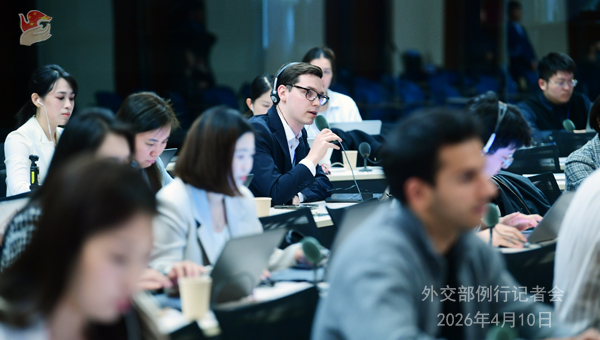
Belteleradio Company: How does the Chinese side assess the current state of Belarusian-Chinese relations, and do the economic ties correspond to the political ones?
Mao Ning: China and Belarus are all-weather comprehensive strategic partners. Over recent years, under the strategic guidance of the two presidents, bilateral relations have achieved sound and steady development, and cooperation in various fields has continued to deepen. In 2025, bilateral trade reached US$ 8.86 billion, up by 5.5 percent year-on-year. China stands ready to work with Belarus, under the fundamental guidance of the important common understandings between the two presidents, to promote the steady growth of bilateral relations.
NHK: The Japanese government published its annual diplomatic bluebook today. Compared with last year, its description of China has changed from one of the most important bilateral relations to an important neighbor. How does the foreign ministry view this change in the wording?
Mao Ning: The root cause for the current situation in China-Japan relations is that Japanese Prime Minister Sanae Takaichi made the erroneous remarks on Taiwan and breached Japan’s commitments, which erodes the political foundation of China-Japan relations and challenges the postwar international order. The Japanese side needs to abide by the four political documents between China and Japan and its own commitments, reflect on and correct its wrongdoings, and take concrete actions to uphold the political foundation of China-Japan relations.
Prensa Latina News Agency: We see the international campaign for Cuba is growing. Recently, U.S. Congress members spoke against the blockade and asked for better relations with the island. They want to prevent and speak out against any U.S. military action against Cuba. What is China’s opinion on this?
Mao Ning: We noted some U.S. lawmakers have visited Cuba recently and expressed opposition to the U.S.’s hostile policy against the country. The U.S. government needs to listen to the just calls and immediately stop the blockade and sanctions as well as coercion and pressuring of any form against Cuba. China stands ready to work with the international community to firmly support Cuba in safeguarding its national sovereignty and security and opposing external interference.