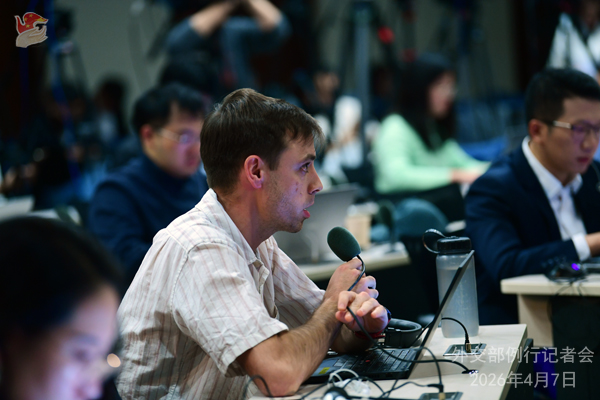
China-Arab TV: President Donald Trump warned Iran that “the entire country can be taken out in one night” if it does not meet his Tuesday deadline of 8 pm to reach a deal. What’s China’s comment?
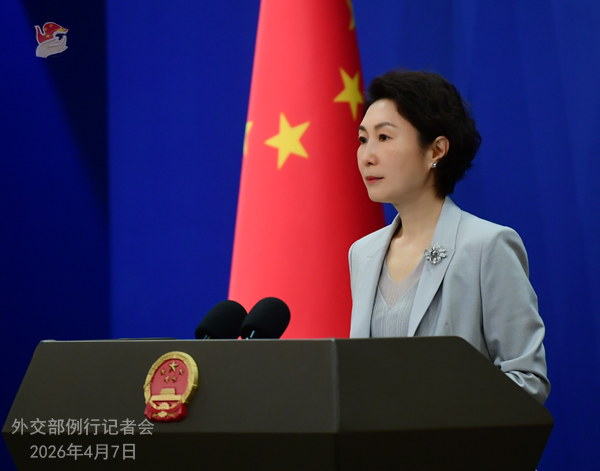
Mao Ning: The ongoing conflict has caused heavy casualties and damage. It is hitting the security and stability of regional countries and impacting the world economy and energy security. China is deeply concerned over this. To prolong or escalate the conflict does not serve any party’s interest. All sides should play a constructive role in deescalating the situation and facilitating peace talks.
BRTV: It’s reported that the Japanese government plans to officially revise the Three Principles on Transfer of Defense Equipment and Technology this month. The draft revision includes: relaxing export rules, which were limited to noncombat defense equipment categories, to allow the export of lethal weapons in principle; introducing exceptions for exports to countries involved in conflicts, leaving room for flexibility; retrospectively notifying the Diet of decisions to export arms instead of prior approval. What’s China’s comment?
Mao Ning: China is gravely concerned. International scholars and those with insights in Japan also find the development deeply concerning and believe it marks a fundamental shift in Japan’s postwar arms export policy and constitutes a grave violation of instruments with legal effect under international law such as the Cairo Declaration, the Potsdam Proclamation and the Japanese Instrument of Surrender. The development goes against Japan’s own Constitution and norms, and will sabotage institutional safeguards designed to prevent the revival of Japan’s militarism. We noted a survey conducted by the Japanese government previously, which shows that the majority of Japanese people oppose relaxing arms export controls.
Various signs show that the Japanese right-wing forces are pushing for a more offensive and expansionist defense policy. Japan’s remilitarization is gathering pace. This is already a reality with an actual roadmap and concrete steps, and this is posing a threat to regional peace and stability. The international community must stay on high alert and firmly reject the reckless moves of Japanese neo-militarism. We urge the Japanese side to deeply reflect on its history of militarist aggression, honor its commitments and act prudently in military and security areas, and stop going further down the wrong path.
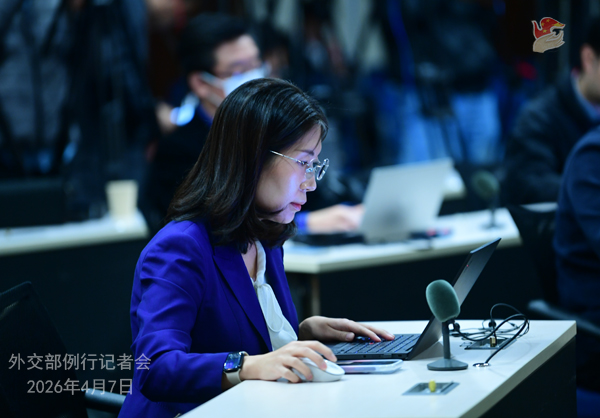
RIA Novosti: Izvestia citing Russia’s foreign ministry reported that China has notified the Russian side of its readiness to extend the visa-free regime for Russians for one year. Can the foreign ministry confirm that?
Mao Ning: China attaches great importance to people-to-people exchanges between China and Russia. We welcome more Russian friends to visit China visa-free and experience our beautiful country.
CGTN: Weeks into the Iran conflict, the two sides continue to exchange military strikes. The closure of the Strait of Hormuz drew widespread concern. There is a growing call for a ceasefire and safe passage. The U.S. and Iran have exchanged some tough rhetoric over the past few days. Sources say the two sides might reach a ceasefire deal. How does China view the situation?
Mao Ning: As we speak, the situation in the Middle East continues to worsen and the military conflict is still escalating, hitting the world economy and energy security and drawing deep concerns from the international community.
Since the conflict began, China has held an objective, just and balanced position and has been working to help bring about a ceasefire and end to the conflict. Foreign Minister Wang Yi made 26 phone calls with parties including Iran, Israel, Russia and the Gulf states. The Special Envoy of the Chinese Government on the Middle East Issue traveled to the region in a mediation effort. Last week, China and Pakistan issued the five-point initiative, which embodies the international consensus for ceasefire and peace.
The use of force does not bring peace. Political settlement is the right way forward. The root cause of the conflict is the U.S.-Israeli launch of military attacks against Iran in violation of international law. The top priority is to bring an immediate end to the military operations and return to dialogue and negotiation, so as to fundamentally resolve the issues and restore peace and stability in the Gulf region. All parties need to demonstrate sincerity and quickly end this war that should not have happened in the first place.
Reuters: Also about the Iran war. So Iran has rejected the U.S. proposal, the proposal that was brokered by Pakistan. In that proposal it sought an immediate ceasefire that would lead to a broader agreement later on. In the midst of all this, Tehran has also refused to lift its blockade of the Strait of Hormuz. I just wanted to ask, was China in favor of that ceasefire proposal, the one that was brokered by Pakistan? And was China able to reach Tehran directly to talk about the proposal? I know you mentioned Minister Wang Yi has made many calls, 26 phone calls. Just wondering, at this point, will China step up its mediation or diplomatic efforts?
Mao Ning: Reaching a ceasefire and resuming dialogue as soon as possible is what the international community hopes to see. China welcomes all efforts conducive to peace and supports Pakistan in making active mediation effort. We hope relevant parties will seize the opportunity for peace, bridge differences through dialogue and put an early end to the conflict. China stands ready to play a constructive role for this end.
Global Times: Former U.S. Ambassador to China Nicholas Burns recently shared his views to U.S. media on China’s position on Iran and Venezuela. How does China respond to those views?
Mao Ning: China noted the views. On Iran and Venezuela, the facts and merits are rather clear and so is China’s position. Mr. Burns tried to frame China in the interview while evading the root cause, used the U.S.’s hegemonic logic to attack and distort China’s just position for peace, and sought to sow discord between China and relevant countries. The motive is simply nefarious.
PTI: Do you have any update on the Pakistan-Afghanistan talks being mediated by China in Urumqi? Do I understand the talks are still going on?
Mao Ning: I provided some information on that last week. China has been making active mediation efforts to facilitate dialogue between Pakistan and Afghanistan. Both sides value and welcome China’s mediation and are willing to sit down for talks. The process for talks is being implemented and advanced steadily. If there is further information, we will release it at an appropriate time. Please check back for updates.
PTI: May I ask you about the UN resolution being piloted by Bahrain at the UN Security Council on the Iran-U.S. conflict? I would like to know what is China’s stand on it? Is this going to be voted today?
Mao Ning: As the conflict regarding Iran continues to spill over, the pressing priority is to actively promote peace talks for the end of the conflict. China believes that any action taken by the UN Security Council should be conducive to easing tensions, stopping the conflict and resuming talks. It should not be used to endorse illegal military moves and still less add fuel to the flame. As a permanent member of the UN Security Council and a major responsible country, China stands ready to play a constructive role in bringing about a ceasefire, restoring peace, and realizing lasting stability in the region.
AFP: My question is about Cheng Li-wun visiting the mainland this week. Her visit is taking place around a month before Donald Trump is due in China. And there are some suggestions that Trump and President Xi will discuss U.S. arms sales to Taiwan when they meet. So first I wondered if you could tell us if Cheng Li-wun and President Xi are going to meet and whether they would discuss arms sales to Taiwan?
Mao Ning: The Taiwan question is China’s internal affair. Cross-Strait relations are not a foreign affairs issue. China has always opposed military contact between the U.S. and the Taiwan region. This position remains clear.