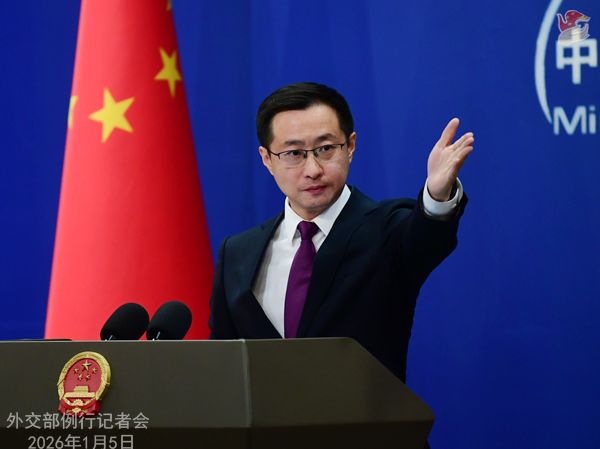
Welcome to the first regular press conference of the Foreign Ministry in the new year. The year 2026 is the first year of the 15th Five-Year Plan period and will witness more achievements of China’s major-country diplomacy with Chinese characteristics. In this changing and turbulent world, we will continue to work with all of you to make China’s voice heard and share China’s stance, so that China and the rest of the world will learn more about and better understand each other.
Shenzhen TV: Saudi Arabia’s Foreign Ministry in a statement released on December 30, 2025 expressed concern over the situation in southern Yemen. On the same day, the United Arab Emirates (UAE) Ministry of Foreign Affairs responded in a statement that the UAE reaffirms its full respect for Saudi Arabia’s sovereignty and national security and its full coordination with Saudi Arabia, and that the UAE respects the sovereignty of Yemen and calls for efforts to prevent escalation. Other members of the Gulf Cooperation Council are confident that Saudi Arabia and the UAE can resolve differences in the spirit of solidarity and coordination, and mutual understanding and accommodation. Yemen’s Presidential Leadership Council recently announced that a dialogue is to be held in Riyadh among Yemen’s southern factions who, including the Southern Transitional Council, do not object to the proposal. Regional countries including Saudi Arabia also welcomed and supported the dialogue. What’s China’s comment?
Lin Jian: China noted the statement released by Saudi Arabia’s Foreign Ministry and the UAE’s response. We commend the two sides for emphasizing on the respect for each other’s sovereignty and security. The legal government of Yemen is widely recognized by the international community. China supports upholding Yemen’s sovereignty, unity and territorial integrity, and welcomes the dialogue to be held in Riyadh among Yemen’s southern factions. We call on parties to remain calm, exercise restraint, resolve differences and disputes through political dialogue, and create conditions for restoring peace and tranquility in Yemen at an early date.
NBC: China has demanded the immediate release of Venezuelan President Nicolás Maduro and his wife from U.S. custody. Can you comment on whether there will be consequences for the U.S. if China’s demand goes ignored? Also, a Chinese delegation was meeting with Nicolás Maduro. Can you confirm whether they are still in Caracas? (Similar questions from Folha de S.Paulo and Bloomberg)
Lin Jian: On your first question, China has stated its position on the U.S. forcibly seizing President Nicolás Maduro and his wife. China expresses grave concern over the U.S. forcibly seizing President Nicolás Maduro and his wife and taking them out of the country. The U.S.’s move is in clear violation of international law, basic norms in international relations, and the purposes and principles of the UN Charter. China calls on the U.S. to ensure the personal safety of President Nicolás Maduro and his wife, release them at once, stop toppling the government of Venezuela, and resolve issues through dialogue and negotiation.
On your second question, China is closely following the security situation in Venezuela. So far there has not been any report about Chinese personnel in Venezuela being affected by the U.S.’s air strikes.
Hubei Media Group: Since the signing of the joint statement between Cambodia and Thailand agreeing to a ceasefire on December 27, 2025, there has been no fighting along the border areas between the two countries. On December 31, Thailand returned 18 Cambodian soldiers. The situation in the border areas has generally eased. What’s China’s comment?
Lin Jian: As the two countries’ friend and close neighbor, China is heartened by the continued implementation of the ceasefire between Cambodia and Thailand and the safe return of 18 Cambodian soldiers to their country. We hope that Cambodia and Thailand will continue to look ahead and move forward, step up dialogue and communication, jointly ensure full and lasting ceasefire, and gradually rebuild trust and improve relations. This serves the fundamental and long-term interests of both Cambodian and Thai people and it is also what the international community hope to see.
China will continue to implement the Global Security Initiative put forward by President Xi Jinping, follow the direction determined by the three countries at Fuxian meeting, actively facilitate in the Asian way the two countries’ effort to achieve a sustained ceasefire and improve their relations, and make due contributions to regional peace and stability and the building of a community with a shared future with neighboring countries.
Spanish Daily ABC: The first one, I would like to ask if the Chinese government has had any kind of interaction with Delcy Rodríguez since she took over as an interim leader of Venezuela? And the second one, President Trump has stated that the U.S. will increase the production of oil industry in Venezuela. Will China continue to import Venezuelan oil as normal? (Similar question from Folha de S.Paulo)
Lin Jian: On your first question, China respects Venezuela’s sovereignty and independence, and believes that the government of Venezuela will properly handle its internal affairs in accordance with the country’s Constitution and laws.
On your second question, the cooperation between China and Venezuela is the cooperation between two sovereign states, which is under protection of international law and the domestic laws of the two countries. No matter how the political situation in Venezuela evolves, China’s willingness to deepen practical cooperation with Venezuela in various fields will not change. China’s lawful interests there will also be protected in accordance with law.
China-Arab TV: U.S. President Donald Trump explicitly stated the change of government in Venezuela and the country’s oil reserves are his main objectives, and he plans to have large United States oil companies go into Venezuela. What’s China’s comment?
Lin Jian: The U.S.’s blatant use of force against Venezuela seriously violates international law and basic norms in international relations, infringes upon Venezuela’s sovereignty, and threatens peace and security in Latin America and the Caribbean region. China has condemned this. Parties need to respect Venezuela’s right to independently choosing development path, and work for stability and the return of order in Venezuela.
TV Tokyo: Venezuela had imported a large amount of military equipment from China, but it appears that this equipment was of little practical use in the recent U.S. attack. Please share your assessment on this matter.
Lin Jian: China firmly supports Latin America and the Caribbean region’s status as a Zone of Peace. We oppose the threat or use of force in international relations, and hegemonic moves of violating the UN Charter and infringing on other countries’ sovereignty.
Yonhap News Agency: The Chinese and ROK presidents are going to have talks. What does China expect to achieve? Could you offer information on the agenda of their talks? When President Lee Jae Myung took off for China yesterday, the DPRK launched ballistic missiles, which violates UN Security Council resolutions. What’s China’s stance?
Lin Jian: China and the ROK are each other’s neighbors and cooperation partners. We hope that under the strategic guidance of the two presidents, the visit will play a positive role in further moving forward the China-ROK strategic cooperative partnership. Information on the specifics of the visit will be released in due course. Please check back for updates.
On the reports about the DPRK’s launch activities, I have no specific comment.
China-Arab TV: U.S. President Donald Trump said on January 4 in a phone interview with The Atlantic magazine that Venezuela may not be the last country that the U.S. will intervene in. He said “We do need Greenland, absolutely.” What’s China’s comment?
Lin Jian: China always advocates that relations between states should be handled in accordance with the purposes and principles of the UN Charter.
Bloomberg: Taiwan officials see the capture by Donald Trump of Venezuela’s Maduro as a powerful deterrent to Beijing. They’ve also added that it highlights the U.S.’s ability to defeat militaries that are equipped with Chinese-made weapons. Finally, they’re also seeing it as a signal to adversaries of the U.S. Does the Foreign Ministry have any comment?
Lin Jian: Taiwan is an inalienable part of China’s territory. The Taiwan question is purely an internal affair of China. How to resolve the Taiwan question is a matter for the Chinese ourselves, and no external forces are in the position of making any interference. The DPP authorities’ disgraceful attempts of soliciting external support to seek “Taiwan independence” and resisting reunification through military buildup are doomed to fail.
Folha de S.Paulo: A statement published by the Ministry of Foreign Affairs says that China urged the U.S. to ensure the personal safety and the immediate release of Maduro and his wife. Was there or will there be any communication between Beijing and Washington regarding this matter?
Lin Jian: China has stated its position on the U.S. forcibly seizing President Nicolás Maduro and his wife.
EFE: Does China consider that the forcible capture of a head of state abroad sets a precedent that could affect international stability and the way sovereignty disputes are handled, and what role does Beijing intend to play in responding to such situation?
Lin Jian: Let me reiterate that China is deeply shocked by and strongly condemns the U.S.’s blatant use of force against a sovereign state and forcible seizure of its president. Such hegemonic acts of the U.S. seriously violate international law and Venezuela’s sovereignty, and threaten peace and security in Latin America and the Caribbean region. China firmly opposes it. We call on the U.S. to abide by international law and the purposes and principles of the UN Charter, and stop violating other countries’ sovereignty and security.
Telesur: The U.S. launched attacks, invasion, and bombing on civilian and military targets and kidnapped President Nicolás Maduro and his wife. China has officially condemned these actions and demanded President Maduro’s release. With the U.N. Security Council meeting imminent, does China plan to propose specific measures in response to the U.S.’s violation of international law and violation of Venezuela’s sovereignty? Additionally, how does China intend to address the kidnapping of President Maduro in concrete terms? (Similar questions from NHK and Anadolu Agency)
Lin Jian: China has stated its position on this. China expresses grave concern over the U.S. forcibly seizing President Nicolás Maduro and his wife and taking them out of the country. The U.S.’s move is in clear violation of international law, basic norms in international relations, and the purposes and principles of the UN Charter. China calls on the U.S. to ensure the personal safety of President Nicolás Maduro and his wife, release them at once, stop toppling the government of Venezuela, and resolve issues through dialogue and negotiation. China supports the UN Security Council in holding an emergency meeting to discuss the U.S. military strikes on Venezuela and supports the Council in playing its due role according to its mandate. We stand ready to work with the international community to firmly defend the UN Charter, the fundamental principles of international justice, and international fairness.
Bloomberg: Trump’s actions in Venezuela can be seen as a real-life example of the Monroe doctrine in action whereby the U.S. claims that the Western Hemisphere is its sphere of influence. Can I ask what’s China’s take on the sphere of influence concept and will the recent events in Venezuela impact China’s commitments in Latin America in terms of economic, military and diplomatic ties? Will there be any modification to China’s strategy for Latin America?
Lin Jian: No matter how the international landscape may evolve, China will always be a good friend and good partner of Latin American and Caribbean (LAC) countries. China’s policy on the LAC region maintains continuity and consistency. We uphold the principle of non-interference in other countries’ internal affairs, respect the choice of the LAC people, and never draw lines along ideological differences. China-LAC exchanges and cooperation follow the principles of equality and mutual benefit, never seek sphere of influence and never target any party. China stands ready to work with LAC countries that have diplomatic relations with China to deepen strategic mutual trust, give each other understanding and support on issues bearing on our core interests and major concerns, including national sovereignty, security and territorial integrity, support each other in following development path that suits each country’s national conditions, and oppose hegemony and power politics.
Anadolu Agency: U.S. President also threatened Colombia and Cuba with intervention after its military operations against Venezuela. Do you think this will kick off a wave of interventions by the U.S. in Latin America and the Caribbean region? And how would China respond in this scenario when your interests are challenged?
Lin Jian: China firmly supports the Latin America and the Caribbean (LAC) region’s status as a Zone of Peace. China opposes any violation of the purposes and principles of the UN Charter and other countries’ sovereignty and security, the threat or use of force in international relations, and external forces’ interference in the internal affairs of LAC countries under any pretext. China and LAC countries are good friends and good partners for equality, mutual benefit and common development. Openness, inclusiveness and win-win cooperation are the hallmark of China-LAC cooperation. LAC countries have the right to independently choosing development paths and cooperation partners. China stands ready to work with LAC countries to continue dealing with the changing international landscape with solidarity and coordination, pursuing development and prosperity through mutually beneficial cooperation and delivering benefits to the two peoples.
AFP: Donald Trump said the U.S. needs Greenland and one of the reasons he gave was because it is “covered with Chinese ships.” Do you have any response to this?
Lin Jian: We urge the U.S. to stop using the so-called “China threat” as a pretext for itself to seek selfish gains.
TV Asahi: The U.S.’s move of forcibly taking the Venezuelan president has shocked the world. Will this affect the U.S. president’s upcoming visit to China in April this year?
Lin Jian: On your question, I have no information to share at the moment.