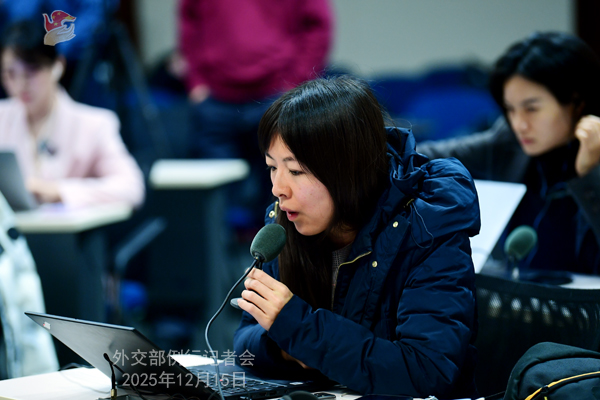
CCTV: On December 13, the National Archives Administration of China published a batch of declassified Russia-provided archives on Soviet interrogations of the Japanese Unit 731 in Khabarovsk. The archives, containing interrogation records of Unit 731 members and investigation reports on the unit’s crimes, once again lay bare Japan’s notorious germ warfare during its aggression against China. What’s your comment?
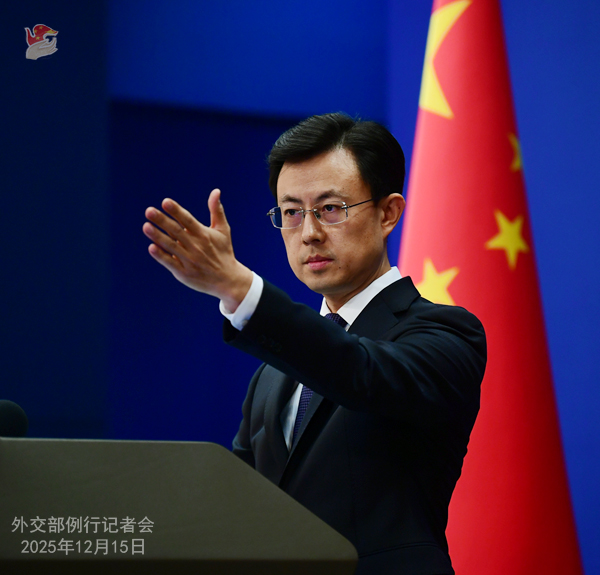
Guo Jiakun: The archives transferred by Russia are yet another piece of ironclad evidence of crimes against humanity committed by the Japanese Unit 731 during its aggression against China and there’s no room for denial.
According to the archives, during the aggression, the Japanese military conducted various live human experiments, including experiments with germ, frostbite, corrosive liquid and erosive gas. Among the victims, there were not only the Chinese people, but also people from the Soviet Union and the Korean Peninsula. The interrogation records disclosed for the first time show that the confession of Kiyoshi Kawashima, former head of Unit 731’s bacterial production department, and other Japanese war criminals detailed the Japanese military’s large-scale use of biological weapons in China in 1940, 1941 and 1942, and the records prove that the application of the experiments in the war aimed at the large-scale destruction of humans.
The trial records in Khabarovsk—supporting and adding more proofs to the files kept by China—together with the site of Unit 731 in China clearly demonstrate how the unit committed crimes in China and prove that the germ warfare was a premeditated, organized, top-down and systematic state crime. Besides in China, the Japanese military established Unit Oka 9420 in Singapore in 1942 and conducted illicit human experiments and waged germ warfare in Southeast Asian countries. Their atrocities will be condemned to perpetual infamy.
Alarmingly, despite those solid facts, right-wing forces in Japan are still trying every means to deny, whitewash and even gloss over the aggression and crimes against humanity. Amnesia of history means betrayal, and denial of responsibility spells repetition of crimes. Every country has the responsibility and obligation to urge Japan to have a complete reckoning with the specter of militarism that still haunts it, never let tragedy repeat itself, jointly uphold the outcomes of the WWII victory and the post-war international order, and safeguard the hard-won world peace and stability.
Xinhua News Agency: It’s reported that the Republican candidate José Antonio Kast won the second round of Chile’s presidential elections and was elected as the next president on Sunday, defeating the candidate of the left-wing governing coalition Jeanette Jara. What’s China’s comment?
Guo Jiakun: China congratulates Mr. José Antonio Kast on his election as the President of Chile.
Chile is the first South American country to establish diplomatic relations with New China. Over the past 55 years since the establishment of diplomatic ties, the bilateral relationship has maintained a sound momentum of development with fruitful cooperation outcomes in various fields. China stands ready to work with the new government of Chile to further step up mutually beneficial and friendly cooperation on all fronts, continue to take China-Chile comprehensive strategic partnership to new heights and bring more benefits to the two peoples.
TV Asahi: The twin giant pandas at Ueno Zoo in Tokyo are scheduled to return to China in late January 2026, which will leave Japan without pandas. Giant pandas are popular among the Japanese people. Does China plan to continue its international cooperation on giant panda conservation with Japan?
Guo Jiakun: I’d refer you to competent authorities for the specifics.
Kyodo News: The Ministry of Foreign Affairs announced today countermeasures against Shigeru Iwasaki, former senior official of Japan’s Self-Defense Forces. What’s the reasons behind this move?
Guo Jiakun: The Taiwan question is at the core of China’s core interests and is the red line that must not be crossed. China firmly opposes Shigeru Iwasaki, the former chief of the Joint Staff of Japan’s Self-Defense Forces, taking the post of so-called “political consultant” of the Taiwan authorities. We have protested to the Japanese side more than once and took countermeasures against Iwasaki. Rather than reflect on and correct his wrongdoings, Iwasaki went down the wrong path by colluding with “Taiwan independence” separatist forces and making provocations. This amounts to a severe violation of the one-China principle and the spirit of the four political documents between China and Japan, a blatant interference in China’s internal affairs, and a grave infringement on China’s sovereignty and territorial integrity. In response to his egregious moves, China, in accordance with the Anti-Foreign Sanctions Law, announced in the decree of the Ministry of Foreign Affairs countermeasures against Shigeru Iwasaki for his collusion with “Taiwan independence” separatist forces and provocations.
CGTN: On the afternoon of December 14, a mass shooting occurred in Sydney, Australia’s largest city, and caused heavy casualties. Can I have your comment on that?
Guo Jiakun: Foreign Minister Wang Yi sent a message of condolences to Minister for Foreign Affairs Penny Wong over the incident. China mourns for the victims and expresses sympathies to the bereaved families and the injured.
Bloomberg: The U.S. State Department has said that China’s water cannoning and cutting of anchor lines in the South China Sea has endangered Filipino fishers. The State Department said that the U.S. will stand with the Philippines to confront “China’s provocative actions and increasingly dangerous tactics against its neighbors.” Does the Foreign Ministry have any comment?
Guo Jiakun: Xianbin Jiao is part of China’s Nansha Qundao. China has indisputable sovereignty over Nansha Qundao, which include Xianbin Jiao, and their adjacent waters. On December 12, the Philippines has taken organized and orchestrated moves to send a large number of ships to make provocations and create trouble in the waters off Xianbin Jiao and intruded into the lagoon of Xianbin Jiao. The Philippines’ so-called fishing ships, despite China’s repeated dissuasion and warning, have deliberately anchored in the lagoon of Xianbin Jiao and repeatedly conducted dangerous maneuvers including veering suddenly off course. The Philippine personnel even threatened China Coast Guard officers with knives who were carrying out rights-defending law enforcement activities. The Philippines’ moves seriously infringe upon China’s sovereignty and rights and interests, violate international law and the Declaration on the Conduct of Parties in the South China Sea (DOC), and sabotage maritime peace and stability. It is legitimate, lawful, professional, restrained and beyond reproach for China to do what is necessary to safeguard our territorial sovereignty and maritime rights and interests. The Philippines needs to immediately stop its infringement, provocations and vilification, stop its endless self-directed stunts at sea, and refrain from challenging China’s firm resolve to safeguard our sovereignty and rights and interests.
The U.S. is not a party to the South China Sea issue and has no right to interfere in the maritime issues between parties concerned. The U.S. needs to stop making fact-distorting and provocative remarks, and stop abetting and supporting the Philippines’ attempt of creating troubles in the South China Sea.
AFP: I’d like to ask about Jimmy Lai who is convicted today in Hong Kong. The UK, Amnesty International, Reporters Without Borders and some NGOs have criticized the conviction today. Does the Foreign Ministry have a response to this?
Guo Jiakun: Hong Kong upholds the rule of law. The Central Government firmly supports the Hong Kong SAR in safeguarding national security and punishing crimes that endanger national security in accordance with the law.
China deplores and firmly opposes certain country blatantly making false accusations against Hong Kong’s judicial affairs. Judicial authorities in Hong Kong SAR fulfill their duties, safeguard the authority of the law and defend national security in accordance with the law. This is justified, legitimate, lawful and beyond reproach. The relevant judicial case is purely Hong Kong’s internal affair. We urge relevant country to respect China’s sovereignty and the rule of law in Hong Kong, and refrain from making irresponsible remarks on the trial of judicial cases in Hong Kong SAR or meddling in Hong Kong’s judicial affairs and interfering in China’s internal affairs in any form.
Shenzhen TV: Despite recent calls made by leaders of relevant countries to leaders of Cambodia and Thailand calling for an early ceasefire, the conflict continues along the border of Cambodia and Thailand. What is China’s comment? What effort has China made to promote a ceasefire between the two countries?
Guo Jiakun: As neighbors and friends of both countries, China follows closely the current developments along the border of Cambodia and Thailand. We are deeply saddened by the casualties inflicted on both sides and express heartfelt sympathies. Cambodia and Thailand are and will always be neighbors. Amity and good-neighborliness are invaluable to a country. The top priority now is to stop the fighting and protect civilians. We hope the two sides will, in light of safeguarding peace and stability of the border areas and the interests of the peoples, exercise maximum restraint, take all measures conducive to realizing a ceasefire, and deescalate as soon as possible.
Since the outbreak of the conflict along the border between Cambodia and Thailand, China in light of the will of the two sides has maintained close communication with both sides via multiple channels and at various levels. We have been actively going between Cambodia and Thailand to promote peace talks, and have created conditions and provided platforms for dialogue between them. China supports the two sides in having direct dialogue and consultation, supports the effort for peace made by ASEAN, especially Malaysia, and supports the effort of finding the solution acceptable to both sides under the framework of ASEAN. China is and will continue to do everything we can to promote talks for peace and play a constructive role in our own way to bring about a ceasefire between Cambodia and Thailand and restore peace.